Reuters reported yesterday (Thursday
16 July 2009) that with China's economic activity picking up in 2009Q2, the Chinese full-year 8% growth target might now be achievable.
Will China save the world?
No one can yet be sure how these latest developments will play out. Of course, upon hearing good news of this kind, nay-sayers are quick to relate how a more pessimistic picture is indicated by other numbers. [Power consumption is usually a good fallback for this - although it's not clear to me which fully fleshed-out economic theory says why that is so.]
Or some say that the good news is likely just unsustainable short-term hot money channeling into propping up only temporarily asset markets and bank lending. [Come to think of it, except for long-term trend growth, doesn't every kind of aggregate demand expansion simply prop up asset markets in the short run? And isn't increasing bank lending exactly what we're trying to do elsewhere in the world? Unsuccessfully at that? At the end of it all, any action that releases 4 trillion units of anything - such as that China has undertaken with its fiscal expansion - has got to have some slippage.]
Finally, there's that portmanteau standby: "I just don't trust these numbers," instantly killing all intellectual debate. That one never grows old.
Perhaps the ambiguity in the current numbers is genuine. So look elsewhere: a historical perspective might be useful.
The 1997 Asian Currency Crisis was, up through 2008, perhaps yet the most wrenching financial and economic crisis in East and Southeast (ESE) Asia. In its concentrated impact on the region, 1997 might well have been just as severe as 2008/2009 for ESE Asia. From June 1997 to mid-January 1998 exchange rates against the US dollar of the currencies of Indonesia, South Korea, Malaysia, the Philippines, and Thailand fell by over 50%; that of Singapore, 20%. In Japan and in every single one of these economies, GDP growth turned negative in 1998, with the combined fall in these economies' 1998 GDP amounting to 2.4% of GDP in ESE Asia the preceding year. Millions of people lost their jobs.
So, if you had been following developments in fast-growing ESE Asia up through before 1997, were then shocked by 1997's sweep through the region, what should you have expected for how wrenching these losses were and how much they perturbed that region's growth path? Here's a graph of the fitted trend line through 1996 of GDP in ESE Asia (excluding Japan), then projected forwards and compared to reality post-1997:

The striking feature in this chart is how little a change in the growth path resulted from what at that time was viewed to be a dramatic downturn. Sure, the accumulated GDP under-performance from 1997 to 2006 was 5.1%. But the same calculation for the world economy overall was 11%, more than double that for ESE Asia, although the world's pre-1996 growth rate was only 3.7% a year in contrast with ESE Asia's 7.6%. Even before the 2008 global financial crisis, the world overall had slowed in comparison to the 4 decades before 1997. But ESE Asia, the centre of that period's financial crisis, emerged far better than one might have expected then.
Or did it? If we exclude not just Japan but also China from ESE Asia, the graph that emerges is quite striking and a little scary:

the accumulated under-performance is then 21%! Through sheer size and economic performance, the significance of China should have been observable even from outer space. This importance of China in aggregate economic performance mirrors its single-handed reduction of the world's poverty over the last three decades (that I've blogged on
previously).
To emphasize further this historical point, recall that prior to 2008 the last two times the US economy went into recession was 1991 and 2001: in 1991 US GDP fell $13.7 bn. In 2001 US GDP grew US$74.1 bn. By contrast, ESE Asia generally and China in particular continued to grow throughout. Taking absolute values, and comparing these changes with those elsewhere gives this table:
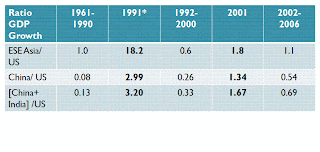
All data here are in constant 2005 US dollars, evaluated at market exchange rates, not purchasing power parity - so the denomination in this comparison is what the whole world would use to buy wide-body Boeing jets, Nokia cellphones, and Italian fashion design.
True, in this comparison, China's per capita income now stands at only 1/14th that of the US; in aggregate, the US economy is still one quarter that of the entire world. But even so and even over relatively long stretches of time (2002-2006) China was already contributing more than half of the growth to the world economy that the US was doing. In times of US and world downturns, however, that ratio rises dramatically: China contributed 3 times what the US failed to do in 1991 (again, using the absolute value of the US change in income), nearly one and a half times the US's contribution in 2001.
Indeed, the rise of China [and to a smaller extent India] since the early 1980s has shifted the world's economic center of gravity 1800 km - 1/3 of the planet's radius - deeper into the Earth's crust, away from the US, and towards the East (previously
blogged). This transition accelerated in 1991 and 2001, each time the US was in recession.
So, perhaps this time, it won't surprise that China leads the world economy out of recession. After all, it's already done so before, quietly.
Notes: I met
John Ross recently, when he and I spoke on a panel on London and the global economic crisis, but hadn't seen his recent post on China's
dramatically shrinking trade surplus, making a similar and more current point than my own post here. I highly recommend his posting.
All data are from the World Bank's World Development Indicators 2008. I provide more details on the numbers I've described above in my paper, "
Post 1990s East Asian economic growth" (October 2008; also Spanish translation in pp. 40-52, Claves de la Economia Mundial 2009, Instituto Espanol de Comercio Exterior, Secretaria de Estado de Comercio, Ministerio de Industria, Espana www.icex.es).


 Posts
Posts
 India, the only other billion-people nation on the planet, has launched itself onto a similar growth path, after a half-century of moribund quiescence. These two giant economies now grow at a pace previously recorded only in easier-to-ignore, special-cased, tiny Far East Asian island nations. This emergence of the East has, in the last three decades, yanked the world’s economic center of gravity nearly 5000 km out of its 1980 mid-Atlantic location eastwards past Helsinki and Bucharest, onto a trajectory aimed squarely at India and China.

 The striking feature in this chart is how little a change in the growth path resulted from what at that time was viewed to be a dramatic downturn. Sure, the accumulated GDP under-performance from 1997 to 2006 was 5.1%. But the same calculation for the world economy overall was 11%, more than double that for ESE Asia, although the world's pre-1996 growth rate was only 3.7% a year in contrast with ESE Asia's 7.6%. Even before the 2008 global financial crisis, the world overall had slowed in comparison to the 4 decades before 1997. But ESE Asia, the centre of that period's financial crisis, emerged far better than one might have expected then.
 the accumulated under-performance is then 21%! Through sheer size and economic performance, the significance of China should have been observable even from outer space. This importance of China in aggregate economic performance mirrors its single-handed reduction of the world's poverty over the last three decades (that I've blogged on previously).
 All data here are in constant 2005 US dollars, evaluated at market exchange rates, not purchasing power parity - so the denomination in this comparison is what the whole world would use to buy wide-body Boeing jets, Nokia cellphones, and Italian fashion design.

